
What is the JCA?
The Joint Clinical Assessment (JCA) is the central component of the EU’s new approach to health technology assessment (HTA), established under Regulation (EU) 2021/2282, creating a permanent framework for conducting clinical assessments jointly at the EU level. This allows Member States to draw on one harmonised assessment, rather than 27 separate evaluations of the same evidence.
The stated aims are straightforward: reduce duplication, strengthen cooperation between national HTA bodies, improve the quality and consistency of clinical evidence assessment, and support faster, more equitable access.
JCA is already mandatory for new oncology products and advanced therapy medicinal products, with coverage expanding to all new orphan medicines in 2028 and all new medicine by 2030. Organisations building experience now, while volumes are still manageable, will be considerably better positioned when the framework covers the whole portfolio.
Figure 1: Phased JCA scope expansion
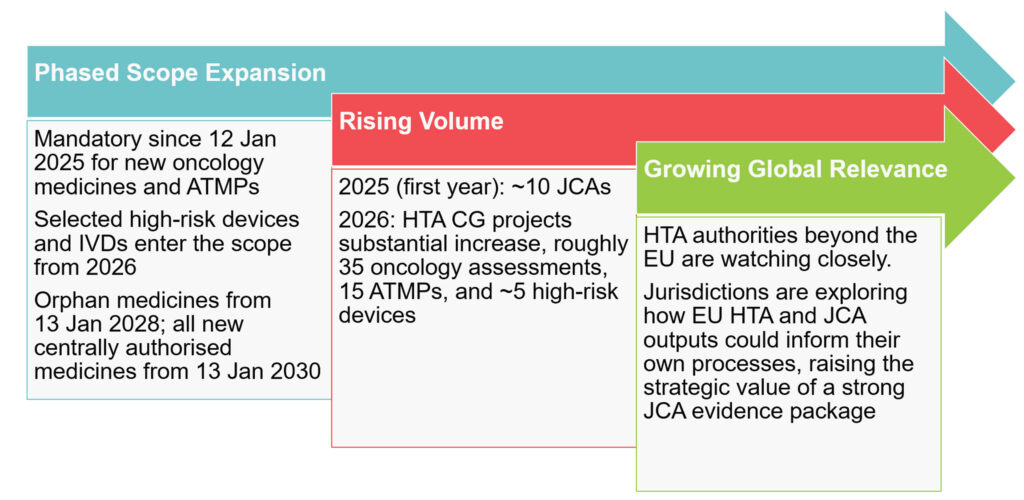
Abbreviations: ATMP, advanced therapy medicinal product; EU, European Union; HTA, health technology assessment; HTA CG, Member State Coordination Group on Health Technology Assessment; IVD, in vitro diagnostic; JCA, joint clinical assessment.
How does the JCA work?
The JCA runs in parallel with the European Medicines Agency (EMA) centralised marketing authorisation procedure. Developers notify the HTA Secretariat at EMA filing, triggering the initiation of the PICO scoping process, providing Member States the opportunity to outline the parameters relevant to their own national HTA needs. Through the scoping survey, Member States identify which patient populations, interventions, comparators, and outcomes should be included in the assessment. The JCA Subgroup consolidates the responses into the final scope, drawing on clinical guidelines and input from patients and clinical experts. The scope is shared with the Health Technology Developer (HTD), coinciding with the Committee for Medicinal Products for Human Use (CHMP) Day 120 list of questions.
The HTD has a fixed (and short!) window to submit the JCA dossier: 100 days for standard procedures, or 60 days for accelerated procedures. Every requested PICO must be addressed, either with comparative evidence or a robust scientific rationale for why the PICO could not be addressed. Subsequent JCA milestones remain tightly linked to the regulatory review process, with several key milestones dependant on EMA decision-making. Following adoption of the CHMP opinion, the HTD has a brief 7-day window (5-days for accelerate procedures) to flag factual inaccuracies and confidential information in the draft JCA report. The final report, endorsed by the HTA Coordination Group, is published within 30-days of the European Commission decision, ensuring a harmonised clinical assessment is available to Member States shortly after regulatory approval.
The framework produces two key publications: the JCA dossier, prepared by the HTD against the assessment scope, and the JCA report, published by the European Commission, providing the common EU-level source of information on relative treatment effects, safety, and other clinical parameters. National bodies must give the report due consideration but not repeat the clinical assessment. Pricing, reimbursement, and value judgments remain national.
Figure 2: Timeline from EMA filing to JCA dossier endorsement
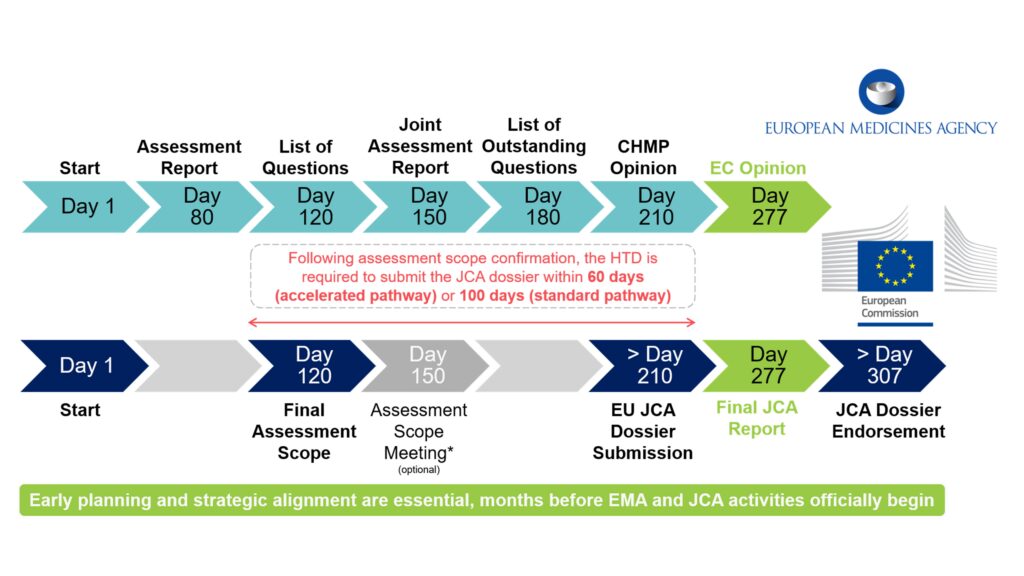
Abbreviations: CHMP, Committee for Medicinal Products for Human Use; EC, European Commission; EMA, European Medicines Agency; HTD, health technology developer; JCA, joint clinical assessment.
What are the challenges with the new framework?
The pressure points the sector predicted prior to the implementation of have proven to be true. PICO scoping remains the hardest part of the process, Member States differ in treatment availability, licensed indications, clinical practice, and off-label use, and those differences translate into comparator heterogeneity. Consolidation reduces the number of research questions without eliminating the underlying divergence, and there is still limited transparency about how consolidation decisions are reached.
The window between final scope and dossier submission is too short to build complex indirect comparisons from scratch. Recurring methodological concerns around risk of bias in single-arm and single-blinded designs, the applicability of non-European trial populations, and the handling of missing data have now concentrated them into one document with EU-wide visibility.
How can these be mitigated?
None of this argues for pessimism; it emphasizes earlier planning. The HTDs who fare best treat PICO anticipation as an evidence generation input rather than a submission task: simulating the likely PICO landscape well before the EMA filing, mapping plausible comparators by market, identifying where indirect comparisons will be needed, and deciding which evidence gaps to close and which to manage as acknowledged uncertainty.
What are we doing at Broadstreet?
At Broadstreet, we have followed the JCA since before the regulation came into application. Preparing for an assessment is less about assembling a dossier at the end of development, than knowing early what the assessment is likely to ask and whether the evidence base can answer it. It rests on the same foundation as everything else we do: a clear view of comparator landscape, evidence synthesis built to withstand methodological scrutiny, and an honest account of where the uncertainty lies.
Since the EU Health Technology Assessment Regulation came into application in January 2025, four JCA reports have now been published by the EC, and for the first time we can describe how the process behaves. In Part 2 of this series, we take each of the four published assessments in turn and look at what they show about how the PICO scope, trial design, and analytical method interact once an assessment is underway.
If you are preparing for a JCA or working out what your evidence base will need to support, please get in touch. Stay tuned for part two of this series, coming soon!